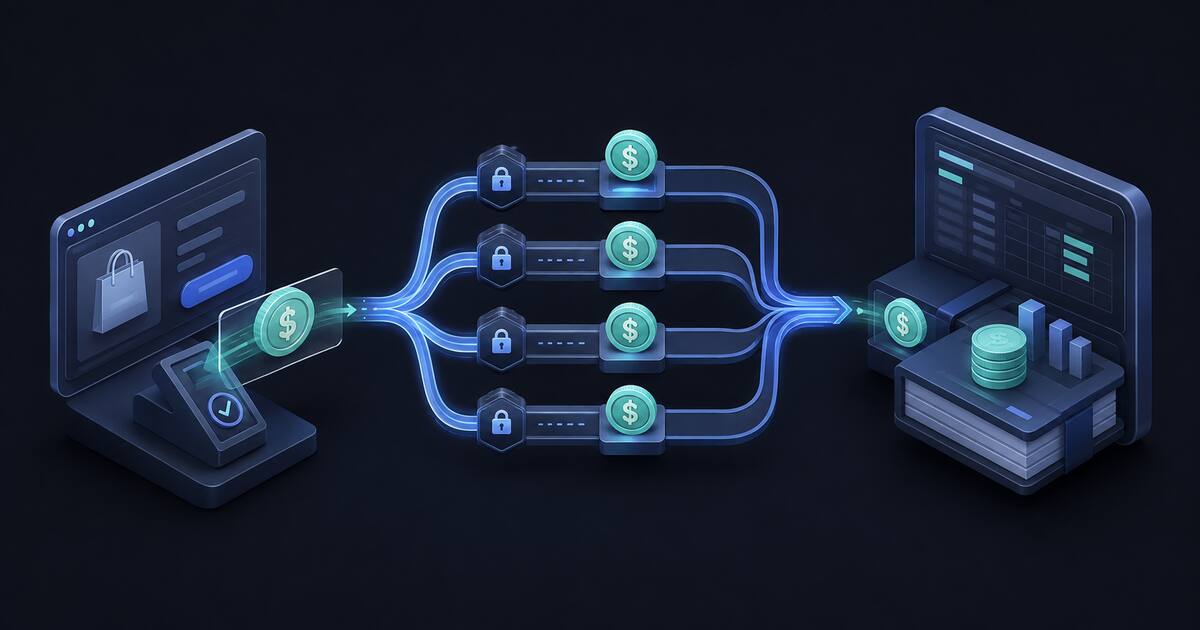
Crypto payment infrastructure is the software and operating layer that accepts digital assets, validates transactions, manages risk, settles value and reconciles payments. It is broader than a wallet. Businesses comparing providers can examine crypto payment infrastructure as one possible operating model, but should evaluate the complete workflow instead of relying only on supported-token counts.
Why a wallet is not a complete payment system
A wallet answers where funds can be received. It does not automatically create an invoice, select a network, identify an underpayment, decide when a transaction is final, screen a counterparty, convert exposure, issue a refund or match a transfer to an order. Those tasks become important as soon as a business accepts frequent payments or serves customers across more than one market.
Infrastructure turns separate actions into defined states: created, awaiting payment, detected, confirmed, settled, refunded or escalated. Each state can have an owner, a time limit and an audit record. This matters when a customer sends the wrong asset, uses the wrong chain, pays too little or requests a refund after settlement.
The layers to evaluate
| Layer | Question |
|---|---|
| Acceptance | How are invoices, addresses, amounts and status shown? |
| Routing | Which asset and network should carry the payment? |
| Risk | How are fraud, sanctions and source-of-funds concerns reviewed? |
| Settlement | Does the merchant keep, convert or hedge the received asset? |
| Payouts | How are suppliers, partners and customers paid? |
| Reconciliation | Can every payment be matched to business records? |
These layers should be tested separately. A provider can simplify checkout while leaving payout approvals to the merchant. Another can provide broad payout coverage while requiring a separate system for customer invoices. The correct comparison depends on the actual flow.
Where stablecoins fit
Stablecoins can reduce the short-term price exposure associated with holding a volatile cryptoasset between receipt and settlement. They do not remove operational or counterparty risk. The issuer, reserve model, redemption process, blockchain, liquidity, transaction costs and legal treatment still require review.
A settlement policy should define the desired result before implementation. One company may accept several assets and convert quickly. Another may keep a controlled stablecoin balance for selected cross-border obligations. A third may require settlement into a local banking relationship. The policy should connect to treasury limits, approval rules and reconciliation.
Controls before launch
- Define payment states: document detected, confirmed, settled, failed and refunded.
- Limit permissions: separate viewing, routing, approval and withdrawal rights.
- Handle exceptions: prepare procedures for wrong-chain payments, underpayments and duplicate references.
- Record evidence: retain order ID, transaction hash, asset, network, fees and settlement destination.
- Stress-test dependencies: model congestion, provider downtime and liquidity gaps.
Common mistakes
Counting supported tokens instead of evaluating usable settlement routes is a common mistake. An asset may be technically accepted but impractical because its network is expensive, liquidity is weak or settlement is unavailable in the required market. Delaying reconciliation design is another mistake: if finance cannot match on-chain activity to orders, more volume creates more manual investigation.
Automation is not a substitute for governance. Someone must set thresholds, approve unusual payouts, review alerts and decide when a transaction is escalated. Stablecoins also do not make compliance questions disappear; they change the asset and settlement profile being assessed.
How to compare providers
Ask each provider to demonstrate the journey from checkout to ledger entry. Test a normal payment, an underpayment, a wrong-network transfer, delayed confirmation, refund and payout to a new destination. Compare the evidence produced at each step and the permissions available to different team members.
“Global” also needs a precise definition. Supported customer locations, payout destinations, fiat settlement, local compliance coverage and banking access are different claims. Record each assumption and recheck it before launch.
Practical takeaway
Crypto payments should be treated as a money-movement operation rather than a single checkout feature. Start with business flows and settlement requirements, then evaluate acceptance, routing, risk, payouts and reconciliation together. The strongest design is one whose limits are understood, whose exceptions have owners and whose records remain verifiable after settlement.