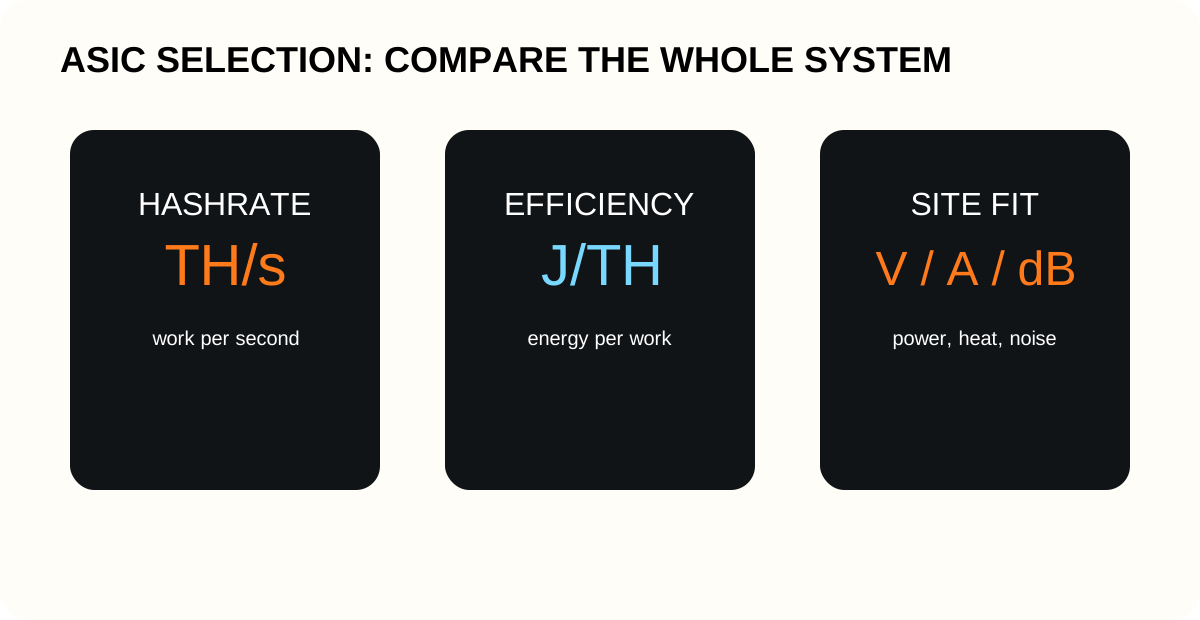
Choose Bitcoin mining hardware by evaluating the complete system: effective SHA-256 hashrate, wall-power draw, joules per terahash, voltage and current requirements, heat, noise, firmware, warranty, repair access, purchase price, and the electricity conditions where the unit will run. A machine is not attractive merely because it has a high terahash rating.
ASICs, not general-purpose computers
Current Bitcoin mining uses application-specific integrated circuits. These devices are engineered for SHA-256 hashing and outperform CPUs and GPUs by orders of magnitude for this task. A computer that can run Bitcoin software is not therefore a competitive miner. The distinction protects buyers from listings that describe old USB devices, cloud-mining contracts, or gaming hardware as realistic Bitcoin production equipment.
Start by documenting the site. Voltage, service capacity, breaker space, continuous-load requirements, receptacles, conductors, ventilation route, noise limits, ambient temperature, dust, humidity, and network availability determine which machines can operate safely. Hardware selection without a site specification reverses the correct order.
Read the specifications correctly
Hashrate is usually stated in terahashes per second. The advertised figure is a nominal operating point, not a guarantee under every temperature, firmware profile, voltage, or unit condition. Pool-side effective hashrate can differ because of downtime, rejected shares, network interruptions, thermal throttling, and statistical variation.
Efficiency in joules per terahash links electrical energy to hashing work. Lower is better when all else is equal, but all else is rarely equal. Acquisition cost, repair history, remaining economic life, power-supply design, available modes, and resale value matter. Compare measured wall power, not only a control-panel estimate.
| Specification | Interpretation | Verification |
|---|---|---|
| TH/s | Nominal hashing throughput | Run a sustained test and compare pool-side work |
| J/TH | Energy per unit of work | Measure wall power and divide by effective hashrate |
| Input voltage | Required supply range | Match manufacturer documentation and site design |
| Power draw | Continuous electrical load | Allow for actual mode and environmental conditions |
| Noise | Acoustic burden | Measure in the intended enclosure and distance |
| Temperature range | Environmental operating limits | Model worst seasonal intake conditions |
Used hardware requires evidence
Request serial numbers, ownership records, clear photographs, firmware version, operating logs, hashrate-board status, temperature history, fan condition, power-supply condition, and a recent sustained test. Cosmetic cleanliness does not prove electrical or chip health. Machines can be cleaned after harsh operation, repaired with mixed parts, or configured to hide unstable chains during a short test.
Define acceptance criteria before payment. State the permitted number of failed chips or boards, test duration, hashrate tolerance, power tolerance, shipping responsibility, damage procedure, and return rights. For a remote purchase, independent inspection can be more valuable than a discount.
Firmware and network security
Use firmware from the manufacturer or a provider whose fee structure, signatures, update process, and security history you understand. Modified firmware can improve tuning, but it can also contain hidden developer fees, remote access, unstable settings, or malicious code. Change default credentials, isolate management interfaces, restrict administrative access, and do not expose the web panel directly to the internet.
Cooling and maintenance
Air-cooled units need clean intake air and a path that prevents exhaust recirculation. Ducting adds resistance, and poorly designed bends or filters can reduce airflow. Immersion systems change fan, fluid, pump, heat-exchanger, materials-compatibility, fire-safety, and maintenance requirements. Neither method removes the need to reject heat from the building.
Keep spare fans, compatible power supplies where justified, cleaning tools, temperature monitoring, and a documented repair path. Track failures by serial number and component. A fleet that appears profitable before repair labor and downtime may not be profitable after them.
Authoritative sources
The Bitcoin developer mining guide explains block construction and proof-of-work mechanics. The Bitcoin Core validation documentation explains that nodes, rather than mining hardware, enforce consensus rules.
Decision process
Reject a listing when the site cannot safely power or cool it, the seller cannot prove condition, the firmware is untrusted, repair support is absent, or the cost model depends on perfect operation. Then compare remaining units by conservative lifetime cash flow rather than headline hashrate. Continue with mining profitability, review pool selection, or return to how to mine Bitcoin.