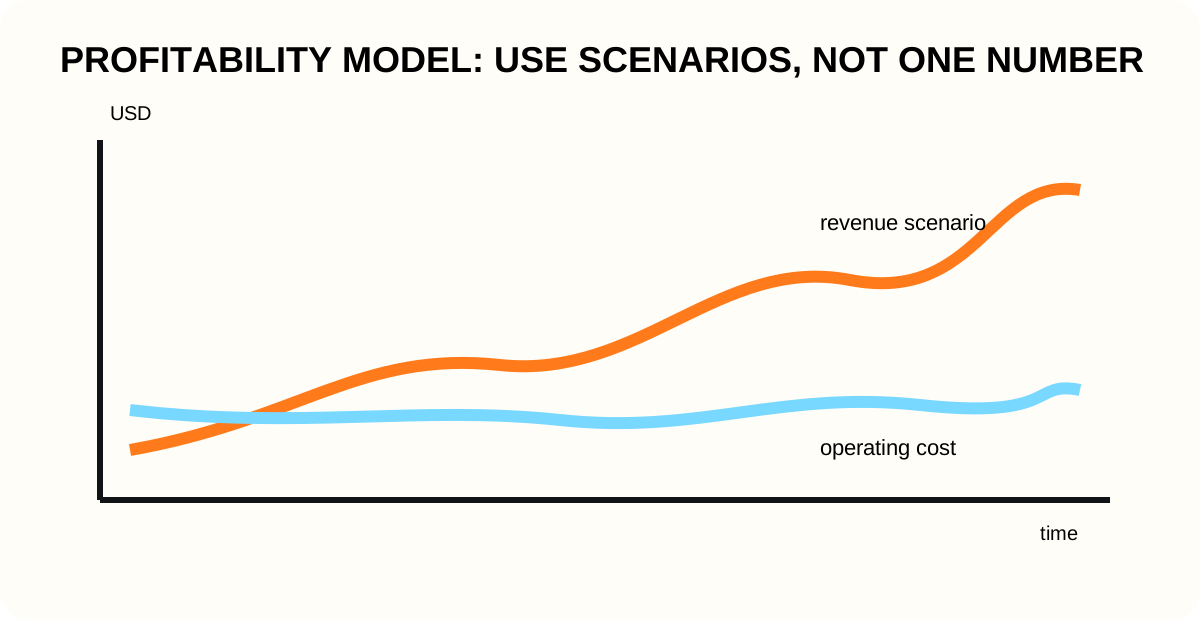
Estimate Bitcoin mining profitability with scenarios, not a single calculator result. Model effective hashrate, wall power, complete electricity price, pool and hosting fees, downtime, repairs, cooling, infrastructure, taxes, hardware cost, difficulty changes, transaction fees, and Bitcoin price. Then test whether the project survives unfavorable combinations rather than only a base case.
Start with physical measurements
Rated hashrate and power are planning inputs. Once the machine operates, use measured wall power and pool-side effective hashrate over a meaningful period. Control-panel values can omit power-supply losses or differ from accepted work. Exclude downtime and rejected shares from unrealistic production assumptions.
Electricity cost should include the actual tariff: energy charge, transmission or distribution components, taxes, demand charges where applicable, seasonal rates, hosting markup, and other contractual fees. A quoted cents-per-kWh number can be incomplete.
Revenue is a moving target
Expected Bitcoin production depends on effective hashrate relative to the network and the rewards available to miners. Network difficulty changes as total hashrate changes. Transaction fees vary with block-space demand. The block subsidy follows its issuance schedule. Pool fees and payout methods change the amount and timing credited to the miner.
Converting production to dollars introduces Bitcoin price risk. A project can produce the expected amount of Bitcoin and still lose money in fiat terms. Conversely, a price increase can hide poor operational performance. Track production and cost in both Bitcoin and the local accounting currency.
Operating contribution versus investment return
Operating contribution subtracts recurring costs from mining revenue. It does not recover hardware purchase price, electrical installation, ventilation, racks, networking, deposits, shipping, customs, financing, or other startup costs. Payback analysis adds those initial costs, but a simple payback period still ignores the timing of cash flows, hardware obsolescence, resale uncertainty, and capital opportunity cost.
| Layer | Examples | Reason to separate |
|---|---|---|
| Revenue | BTC production, fee treatment, BTC price | Changes with network and market conditions |
| Variable cost | Electricity, pool fee, revenue share | Moves with runtime or production |
| Fixed operating cost | Rent, connectivity, monitoring, labor | Continues during low production |
| Maintenance | Fans, PSU, hashboards, cleaning, downtime | Often omitted from simple calculators |
| Capital | ASIC, wiring, cooling, shipping, deposits | Must be recovered before investment profit |
Build three scenarios
A base case should use defensible current inputs and measured performance. A downside case should combine lower Bitcoin price, higher difficulty, reduced uptime, and repair expense. An operational case should model a machine failure, hosting interruption, curtailment, or tariff increase. A project that fails under modest stress deserves additional margin before capital is committed.
Do not assume that higher network difficulty reverses, that hardware retains a fixed resale value, or that electricity price remains unchanged. Scenario ranges should be wide enough to represent the volatility already observed in mining markets.
Break-even electricity price
Break-even power price asks how much can be paid for electricity after other operating costs while contribution remains zero. It is useful for comparing sites, but it is not a full investment decision. A machine can operate above electricity break-even and still never recover hardware and infrastructure cost.
Calculate a separate shutdown price if the hardware is already owned. When expected revenue no longer covers avoidable operating cost, temporary shutdown may reduce losses. Contract obligations, restart costs, demand charges, heat-reuse value, and pool terms can change that threshold.
Hosting contracts
Translate every hosting term into the model: setup fee, deposit, minimum term, power formula, management fee, repair labor, parts markup, curtailment, revenue share, insurance, late fees, termination, shipping, and machine retrieval. Model the possibility that equipment cannot be accessed or relocated quickly.
Taxes and records
Tax treatment depends on jurisdiction, entity, accounting method, and circumstances. Keep acquisition invoices, serial numbers, electricity bills, hosting statements, pool reports, payout transaction IDs, wallet records, repair invoices, and disposal records. Consult a qualified professional instead of deriving tax treatment from a generic mining calculator.
Authoritative sources
The Bitcoin developer blockchain guide explains the consensus and proof-of-work context behind block production. Public filings such as MARA’s 2026 quarterly filing show that professional miners track energized hashrate, production, fleet scale, and energy costs, while also warning that network hashrate and difficulty affect output. A public company’s costs are not a retail miner’s forecast.
Decision rule
Use conservative assumptions, require a margin for uncertainty, and compare mining with simply purchasing Bitcoin or allocating capital elsewhere. The technically possible option is not automatically the economically rational option. Continue to hardware selection, review pool mechanics, visit the guides hub, or return to how to mine Bitcoin.