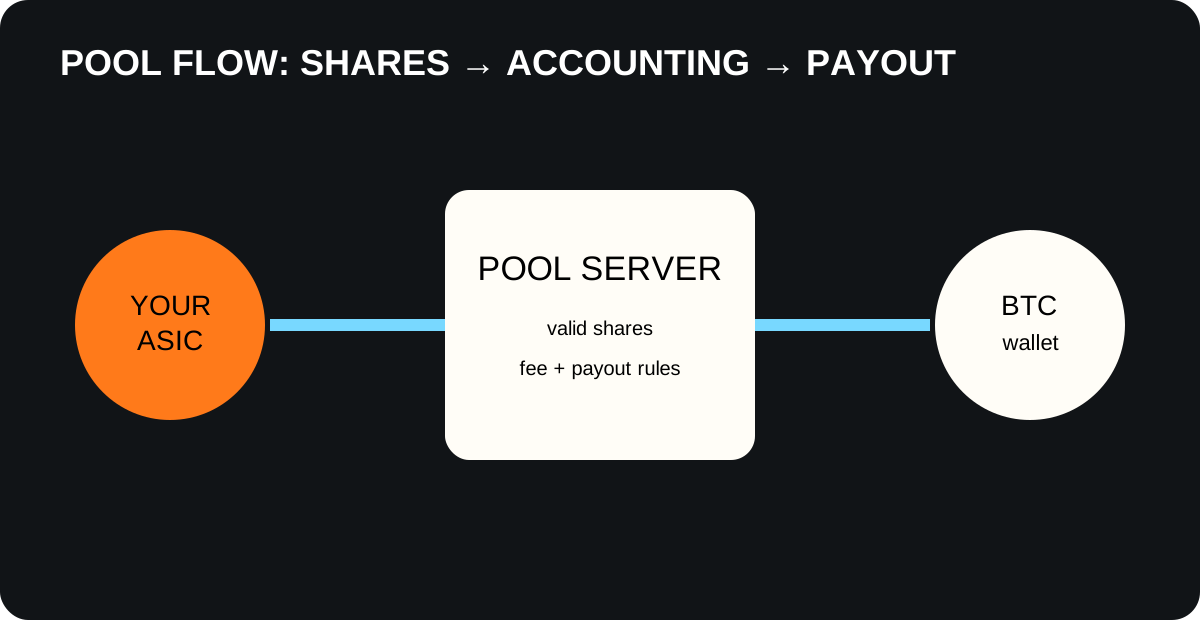
A Bitcoin mining pool combines work from many miners, estimates each participant’s contribution through shares, and distributes revenue according to a published payout method. A pool reduces payout variance for small miners, but it introduces fees, server dependence, accounting rules, account security, and counterparty risk.
Why miners join pools
Solo block discovery is probabilistic. A miner with a tiny fraction of network hashrate may have a very long expected interval between blocks and can experience results far above or below that average. Pools aggregate hashrate and use lower-difficulty shares to measure contributed work, allowing participants to receive smaller, more frequent payouts.
A share demonstrates that a miner found a hash below the pool’s share target. It usually does not meet the much harder Bitcoin network target. Shares let the pool estimate work without waiting for each miner to find a full block. The pool must define how valid, stale, duplicate, and rejected shares affect credit.
Payout methods change who carries variance
Pay-per-share and full-pay-per-share methods generally credit valid work without waiting for a specific round to produce a block, so the operator carries more short-term variance and prices that risk into fees or reserves. Proportional, score, and pay-per-last-N-shares methods tie payment more closely to blocks found and the timing or position of shares.
Do not infer terms from an acronym alone. Read the current formula and examples. Determine whether transaction fees are included, how orphaned blocks are treated, whether payout credit can be reversed, how stale shares are handled, and whether fees are deducted from earnings or payouts.
| Pool check | What to confirm |
|---|---|
| Payout formula | Exact calculation, variance allocation, and transaction-fee treatment |
| Pool fee | Headline percentage plus any withdrawal or conversion charges |
| Threshold | Minimum balance, schedule, and inactive-account rules |
| Servers | Regions, ports, encryption support, redundancy, and status reporting |
| Account controls | MFA, address locks, change delays, notifications, and session history |
| Transparency | Blocks, hashrate, fee policy, incidents, and support record |
Server selection and stale shares
Choose a nearby, reliable server endpoint and configure backups where the ASIC supports them. Latency alone is not the only concern; packet loss, unstable routing, DNS failures, and pool-side incidents can interrupt work. A miner can appear powered and hashing locally while submitting no useful work.
Stale shares are work based on an old job after the pool has moved to a new block template. Some stale shares are inevitable, but persistent elevation can indicate latency, network loss, overloaded equipment, firmware problems, or pool issues. Rejected shares can also result from invalid work, duplicate submissions, incorrect difficulty handling, or misconfiguration.
Pool account and wallet security
Use a unique password and phishing-resistant multi-factor authentication where available. Bookmark the correct domain, restrict email-account access, review active sessions, and enable notifications. Confirm whether payout-address changes are delayed or locked. A compromised account can redirect future payouts even while the ASIC continues operating normally.
Verify the Bitcoin address character by character and retain wallet backups before mining. Understand whether the pool pays on-chain, through an internal balance, or through another settlement method. Record payout transaction IDs, pool statements, worker statistics, fees, and address changes for accounting and incident investigation.
Centralization and counterparty risk
Pool participation does not transfer Bitcoin consensus validation to the pool, because full nodes independently validate blocks. However, a pool often selects transaction templates and coordinates substantial hashrate. Operators should understand the concentration implications and consider template-transparency or miner-selection mechanisms where supported.
A pool can experience insolvency, hacks, withholding disputes, software faults, account freezes, policy changes, or service termination. Avoid leaving balances above a reasonable operating threshold. Test withdrawals before allowing a large balance to accumulate.
Authoritative sources
The Bitcoin developer mining guide documents mining and pool-related protocol concepts. The Bitcoin peer-to-peer networking reference provides context for block and transaction propagation.
Pool setup checklist
- Read the complete payout formula and fee policy.
- Verify the operator, support history, status page, and incident communication.
- Configure primary and backup endpoints.
- Use unique worker names and document which device each represents.
- Enable MFA and payout-address protection.
- Verify pool-side hashrate, accepted shares, and stale rate after startup.
- Test the first payout and keep records.
Return to the guides hub, compare ASIC hardware, review profitability assumptions, or start with how to mine Bitcoin.